NCERT Class 9 Maths Chapter 11 Constructions Exercise 11.2


Chapter 11 Constructions Exercise 11.2

Question 1: Construct a triangle ABC in which BC = 7cm, ∠B = 75° and AB + AC = 13 cm.
Answer:

Given:

Triangle ABC in which BC = 7cm, ∠B = 75° and AB + AC = 13 cm

Rough figure:
Actual figure:
Construction steps:
1. Draw line segment BC = 7 cm.
2. Make ∠CBX = 75°.
3. With B as centre and radius sum of AB and AC i.e. 13 cm draw an arc to cut ray BX at D.
4. Join DC.
5. Now draw the perpendicular bisector of DC and let this bisector meet BD at A.
6. Join AC. Therefore, ABC is the required triangle.

Question 2: Construct a triangle ABC in which BC = 8cm, ∠B = 45° and AB - AC = 3.5 cm.
Answer:

Given:
Triangle ABC in which BC = 8cm, ∠B = 45° and AB - AC = 3.5 cm.

Rough figure:
Actual figure:
Construction steps:
1. Draw line segment BC = 8 cm.
2. Make ∠CBX = 45°.
3. With B as centre and radius difference of AB and AC i.e. 3.5 cm draw an arc to ray BX at D.
4. Join CD. Now draw the perpendicular bisector of CD and let this bisector intersect ray BX at A.
5. Join AC. Therefore, ABC is the required triangle.

Question 3: Construct a triangle PQR in which QR = 6cm, ∠Q = 60° and PR–PQ = 2cm.
Answer:

Given:

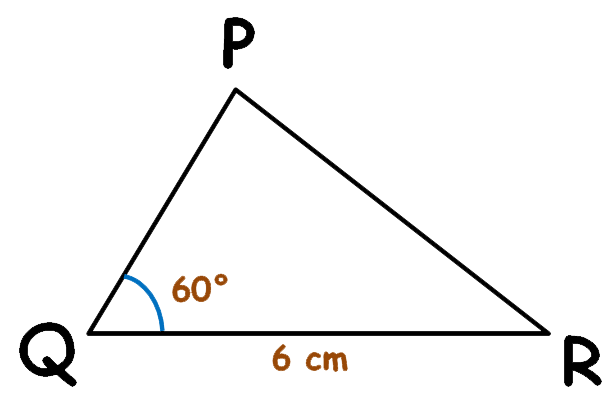
Triangle PQR in which QR = 6cm, ∠Q = 60° and PR–PQ = 2cm.

Rough figure:
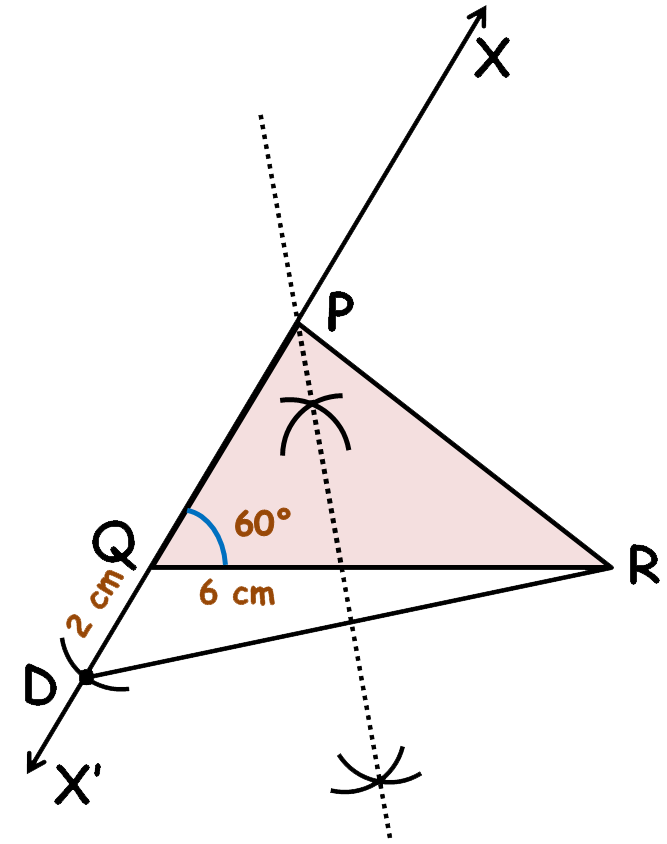
Actual figure:
Construction steps:
1. Draw line segment QR = 6 cm.
2. Make ∠RQX = 60°. Extend ray QX downwards till X’.
3. With Q as centre and radius difference of PR and PQ i.e. 2cm draw an arc to cut ray QX’ at D.
4. Join DR. Draw the perpendicular bisector of DR. Let this perpendicular bisector meet ray QX at P.
5. Join PR. PQR is the required triangle.
 
Question 4: Construct a triangle XYZ in which ∠Y = 30°, ∠Z = 90° and XY+YZ+ZX = 11 cm.
Answer:

Given:

Triangle XYZ in which ∠Y = 30°, ∠Z = 90° and XY+YZ+ZX = 11 cm.

Rough figure:
Actual figure:
Construction steps:
1. Draw line segment PQ = 11 cm (which is the sum of XY, YZ and ZX).
2. Make ∠QPA = 30° and ∠PQS = 90°.
3. Draw the angular bisector of ∠QPA and ∠PQS. Extend these bisectors till they meet at X.
4. Draw perpendicular bisectors of PX and QX. Let this meet at Y and Z respectively.
5. Join XY and XZ. Therefore, XYZ is the required triangle
 

Question 5: Construct a right triangle whose base is 12cm and sum of its hypotenuse and other side is 18 cm.
Answer:

Given:

A right triangle whose base is 12cm and sum of its hypotenuse and other side is 18 cm.

Rough figure:
Actual figure:
Construction steps:
1. Draw line segment BC = 12 cm.
2. Make ∠BCX = 90°.
3. With C as centre and radius sum of hypotenuse and a side i.e. 18 cm, draw an arc on ray CX to intersect at D.
4. Join BD. Draw the perpendicular bisector of BD. Extend this bisector to meet ray CX at A.
5. Join AB. ABC is the required triangle.

No comments:

Post a Comment

Also read!

Click on any of the below text for additional links:

Class 6

→ Class 6 Computer Kips Solutions
→ Class 6 Gul Mohar English Solutions
→ Class 6 Map Pointing Solutions
→ Class 6 NCERT Civics Solutions
→ Class 6 NCERT Geography Solutions
→ Class 6 NCERT History Solutions
→ Class 6 NCERT Maths Solutions
→ Class 6 NCERT Science Solutions

Class 7

→ Class 7 Computer Kips Solutions
→ Class 7 Gul Mohar English Solutions
→ English Grammar Class 7
→ English Writing Skills Class 7
→ Class 7 Map Pointing Solutions
→ Class 7 NCERT Civics Solutions
→ Class 7 NCERT Civics Notes
→ Class 7 NCERT Civics Extra Questions
→ Class 7 NCERT Geography Solutions
→ Class 7 NCERT Geography Notes
→ Class 7 NCERT Geography Extra Questions
→ Class 7 NCERT History Solutions
→ Class 7 NCERT History Notes
→ Class 7 NCERT History Extra Questions
→ Class 7 NCERT Maths Solutions
→ Class 7 NCERT Science Solutions
→ Class 7 NCERT Science Notes
→ Class 7 NCERT Science Extra Questions

Class 8

→ Class 8 Kips Artificial Intelligence Solutions
→ Class 8 Gul Mohar English Solutions
→ English Grammar Class 8
→ English Writing Skills Class 8
→ Class 8 Map Pointing Solutions
→ Class 8 NCERT Civics Solutions
→ Class 8 NCERT Civics Notes
→ Class 8 NCERT Civics Extra Questions
→ Class 8 NCERT Geography Solutions
→ Class 8 NCERT Geography Notes
→ Class 8 NCERT Geography Extra Questions
→ Class 8 NCERT History Solutions
→ Class 8 NCERT History Notes
→ Class 8 NCERT History Extra Questions
→ Class 8 NCERT Maths Solutions
→ Class 8 NCERT Science Solutions
→ Class 8 NCERT Science Notes
→ Class 8 NCERT Science Extra Questions
→ Class 8 NCERT Science Exemplar
→ Class 8 NCERT Science MCQs

Class 9

→ Class 9 Kips Artificial Intelligence Solutions
→ Class 9 Map Pointing Solutions
→ Class 9 NCERT Civics Solutions
→ Class 9 NCERT Geography Solutions
→ Class 9 NCERT History Solutions
→ Class 9 NCERT Maths Solutions
→ Class 9 NCERT Science Solutions

Class 10

→ Class 10 Kips Artificial Intelligence Solutions
→ Class 10 NCERT English Solutions
→ Class 10 Map Pointing Solutions
→ Class 10 NCERT Civics Solutions
→ Class 10 NCERT Civics Notes
→ Class 10 NCERT Civics Extra Questions
→ Class 10 NCERT Geography Solutions
→ Class 10 NCERT Geography Notes
→ Class 10 NCERT Geography Extra Questions
→ Class 10 NCERT History Solutions
→ Class 10 NCERT History Notes
→ Class 10 NCERT History Extra Questions
→ Class 10 NCERT Maths Solutions
→ Class 10 NCERT Science Solutions
→ Class 10 NCERT Science Notes
→ Class 10 NCERT Science Extra Questions

Computer Languages

→ Python Basics

Extra Activities

→ Extra Activities

Extra Knowledge

→ Extra Information
→ General Knowledge
→ Historical Places in India
→ Latest technology
→ Physical Sciences
→ Facts

• Mathematics quick links
→ Mathematical Terms
→ Maths Tricks

Home Top