NCERT Class 8 Maths Chapter 5 Data Handling Exercise 5.1


Chapter 5 Data Handling Exercise 5.1

Question 1: For which of these would you use a histogram to show the data:
a) The number of letters for different areas in a postman’s bag.
b) The height of competitors in an athletics meet.
c) The number cassettes produced by 5 companies.
d) The number of passengers boarding trains from 7.00 a.m. to 7.00 p.m. at a station. Give reason for each.
Answer:
A histogram is a graphical representation of a grouped frequency distribution with continuous classes.
The cases mentioned in options (b) and (d) can be divided into class intervals, histogram can be used to show the data.
The cases mentioned in options (a) and (c) cannot be divided into class intervals, histogram cannot be used to represent the data.

Question 2: The shoppers who come to a departmental store are marked as: man (M), woman (W), boy (B) or girl (G). The following list gives the shoppers who came during the first hour in the morning.
W W W G B W W M G G M M W W W W G B M W B G G M W W M M W W W M W B W G M W W W W G W M M W M W G W M G W M M B G G W.
Make a frequency distribution table using tally marks. Draw a bar graph to illustrate it.
Answer:

Frequency distribution table:
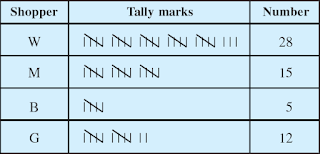

Bar-graph:


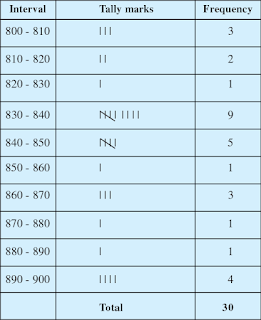
Question 3: The weekly wages (in ₹) of 30 workers in a factory are:
830, 835, 890, 810, 835, 836, 869, 845, 898, 890, 820, 860, 832, 833, 855, 845, 804, 808, 812, 840, 885, 835, 835, 836, 878, 840, 868, 890, 806, 840.
Using tally marks, make a frequency table with intervals as 800 - 810, 810 - 820 and so on.
Answer:
The frequency table with intervals as 800 - 810, 810 - 820 and so on, using tally marks is given below:
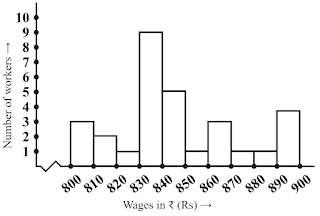

Question 4: Draw a histogram for the frequency table made for the data in Question 3 and answer the following questions.
(i) Which group has the maximum number of workers?
(ii) How many workers earn ₹ 850 and more?
(iii) How many workers earn less than ₹ 850?
Answer:

i) 830-840 is the group having maximum number of workers.
ii) 10 workers are earning ₹850 and more.
iii) 20 workers are earning less than ₹850.

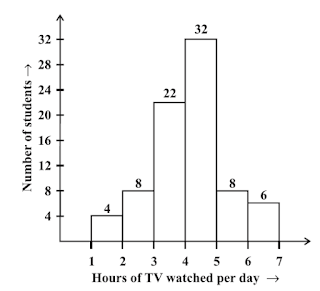
Question 5: The number of hours for which students of a particular class watched television during holidays is shown through the given graph.
Answer the following:
(i) For how many hours did the maximum number of students watch T.V.?
(ii) How many students watched TV for less than 4 hours?
(iii) How many students spent more than 5 hours in watching TV?
Answer:

(i) The maximum number of students who watched T.V. for 4 - 5 hours.
(ii) The number of students who watched T.V. less than 4 hours are 34.
(iii) The number of students who spent more than 5 hours in watching T.V. are 14.

No comments:

Post a Comment

Also read!

Click on any of the below text for additional links:

Class 6

→ Class 6 Computer Kips Solutions
→ Class 6 Gul Mohar English Solutions
→ Class 6 Map Pointing Solutions
→ Class 6 NCERT Civics Solutions
→ Class 6 NCERT Geography Solutions
→ Class 6 NCERT History Solutions
→ Class 6 NCERT Maths Solutions
→ Class 6 NCERT Science Solutions

Class 7

→ Class 7 Computer Kips Solutions
→ Class 7 Gul Mohar English Solutions
→ English Grammar Class 7
→ English Writing Skills Class 7
→ Class 7 Map Pointing Solutions
→ Class 7 NCERT Civics Solutions
→ Class 7 NCERT Civics Notes
→ Class 7 NCERT Civics Extra Questions
→ Class 7 NCERT Geography Solutions
→ Class 7 NCERT Geography Notes
→ Class 7 NCERT Geography Extra Questions
→ Class 7 NCERT History Solutions
→ Class 7 NCERT History Notes
→ Class 7 NCERT History Extra Questions
→ Class 7 NCERT Maths Solutions
→ Class 7 NCERT Science Solutions
→ Class 7 NCERT Science Notes
→ Class 7 NCERT Science Extra Questions

Class 8

→ Class 8 Kips Artificial Intelligence Solutions
→ Class 8 Gul Mohar English Solutions
→ English Grammar Class 8
→ English Writing Skills Class 8
→ Class 8 Map Pointing Solutions
→ Class 8 NCERT Civics Solutions
→ Class 8 NCERT Civics Notes
→ Class 8 NCERT Civics Extra Questions
→ Class 8 NCERT Geography Solutions
→ Class 8 NCERT Geography Notes
→ Class 8 NCERT Geography Extra Questions
→ Class 8 NCERT History Solutions
→ Class 8 NCERT History Notes
→ Class 8 NCERT History Extra Questions
→ Class 8 NCERT Maths Solutions
→ Class 8 NCERT Science Solutions
→ Class 8 NCERT Science Notes
→ Class 8 NCERT Science Extra Questions
→ Class 8 NCERT Science Exemplar
→ Class 8 NCERT Science MCQs

Class 9

→ Class 9 Kips Artificial Intelligence Solutions
→ Class 9 Map Pointing Solutions
→ Class 9 NCERT Civics Solutions
→ Class 9 NCERT Geography Solutions
→ Class 9 NCERT History Solutions
→ Class 9 NCERT Maths Solutions
→ Class 9 NCERT Science Solutions

Class 10

→ Class 10 Kips Artificial Intelligence Solutions
→ Class 10 NCERT English Solutions
→ Class 10 Map Pointing Solutions
→ Class 10 NCERT Civics Solutions
→ Class 10 NCERT Civics Notes
→ Class 10 NCERT Civics Extra Questions
→ Class 10 NCERT Geography Solutions
→ Class 10 NCERT Geography Notes
→ Class 10 NCERT Geography Extra Questions
→ Class 10 NCERT History Solutions
→ Class 10 NCERT History Notes
→ Class 10 NCERT History Extra Questions
→ Class 10 NCERT Maths Solutions
→ Class 10 NCERT Science Solutions
→ Class 10 NCERT Science Notes
→ Class 10 NCERT Science Extra Questions

Computer Languages

→ Python Basics

Extra Activities

→ Extra Activities

Extra Knowledge

→ Extra Information
→ General Knowledge
→ Historical Places in India
→ Latest technology
→ Physical Sciences
→ Facts

• Mathematics quick links
→ Mathematical Terms
→ Maths Tricks

Home Top